
Which String Did That Just Pluck? Where Relationship Drama Comes From

When I was young, I used to sulk. And it was awful. A feeling of inner tension and of not being appreciated would choke me, and I had to wait for it to pass. There was nothing I could do about it.
That's one way through, too, and it's fine. It just isn't very pleasant while it lasts.
Today I know there's another way. You can step back right there in the middle of the situation and name what's happening. But to do that, I need to see where the drama comes from. As I see it, it lies beneath the surface of the relationship, in the first three chakras, the three lowest floors of our energy system.
I'll mostly be writing about romantic partnership. But in slightly different shades, it applies to every relationship.
I'm describing extremes, but this touches all of us
What I'm going to describe is the extreme end: the patterns of people who are badly out of balance in this area.
On some level, though, every one of us has run into this. We all have days when the first chakra is weak and we feel unsteady. Sometimes it's a faint breeze we barely notice. Sometimes we wrestle with it for two hours or half a day, other times for a month or a year. And for some people, it's a lifelong pattern.
I see it in myself, too. The themes that were active in me when my kids were small weren't the ones that came up later, as they grew more independent. It's still the same energy system. Each season of life just brings something different to the surface.
And I'm not talking about the shadows so we can point fingers at anyone. I want us to see these patterns in ourselves first. Then we'll see them in others too, and I hope that compassion and understanding will grow in us instead of judgment.
Three floors under every relationship
Picture a tree. The first three chakras are its roots and the lower part of its trunk. That's what determines how the tree takes in nourishment and water, how it communicates with what's around it, and whether the wind will knock it down. What grows above matters too. But without the base, none of it would stand.

In myself and in others, I've noticed that the biggest old hurts live on exactly these three floors. This is where most of our inner attitudes, beliefs, prohibitions and musts get stored, because the foundation is laid before birth and in the first years of life. On top of it grow more and more ideas about how I must and mustn't behave.
When a floor goes hungry
The first floor: safety. This is the chakra of stability, and it sits at the very bottom. When it isn't nourished and lacks a sense of safety, a fear of abandonment can show up in the relationship. The person is afraid their partner will leave, and every time the partner walks out the door, it feels like a threat. They don't want to let their partner go anywhere, and they need to share absolutely everything with them. It's that suction-cup kind of love, the kind that smothers.
The same instability can show up the other way around, as a fear of commitment, of promises and of anything official. The person feels they'd lose their freedom and would have to put down real roots, and their first floor isn't ready for that. Overreacting to small things in the relationship belongs here too, and sometimes so does doubting whether I'll be taken care of financially. It can go as far as keeping a tally of who bought what and for how much, so that everything is perfectly even. Every last penny gets counted.
The second floor: closeness and joy. Below the navel sits the chakra that carries intimacy, passion and joy. When it isn't working as well as it could, a person may struggle to surrender and let the other person in. As if they couldn't allow themselves to experience what it's like to be really close to someone. They're missing the juiciness and joy of life.
That can lead to jealousy that needs no real reason. The person imagines their partner being stolen by someone whose second floor works. Control can join in: the eighty texts a day, the twenty-three missed calls, the need to know where the other person is every minute. Emotions swing up and down. Out of fear of losing the other person, they sometimes push those emotions down, and that ends either in shutting down completely or in explosions.
Understanding where the control comes from doesn't mean you have to put up with it. Compassion makes room for a conversation. But when someone crosses your boundaries, you're allowed to say no and to set rules that feel right to you.
The third floor: self-respect and boundaries. In the stomach area, in the solar plexus, sits the chakra connected with power, self-expression and boundaries. When self-respect is missing here, a person can become very dependent on praise. They need the other person to keep telling them how wonderful they are and to keep bringing up their past achievements. Back then, three years ago, you built that sandbox. Back then, you made everyone that fantastic lunch. The sense of being important has to be fed from the outside, over and over, with attention and admiration.
Other times, partners turn into rivals. They go hiking together and one of them has to be in front. Instead of teamwork and the sense that we're in this together, there's constant one-upmanship in the relationship, an effort to prove to the other person that I'm better. This applies to men and women alike.
And then there's the wounded silence. Sometimes a person who didn't get enough admiration and respect takes offense, shuts down, stops talking and feels unappreciated. Sometimes it goes as far as reproaches and poisoned arrows. The fear of rejection lives on the third floor too, so some people would rather run from a conflict than face someone who disagrees with them.
I was pretty good at sulking myself when I was young.
Look inside, open nothing
You can look at these three floors in yourself. It isn't exactly a meditation. We won't activate anything here. We'll just check how the little stream of energy is doing there, the one we received from Mom and Dad and cultivate with our own lives.
- Set the intention that you'll only take a peek. You're not diving in anywhere, you're just looking.
- Sit with a straight spine, so your whole torso points up toward the ceiling.
- Send your attention to the base of your spine, to the place you're sitting on. With your inner eye, notice how the first chakra glows there: its intensity, its color and its shade.
- See yourself at a moment when your first floor isn't content. What's happening in your life?
- Then change the picture and look at how you live when that floor is completely content and joyful.
- Do the same below your navel, and then in the stomach area. Feel out each floor with your inner eye, its light and how warm or cool its color is. First, simply as an observer, watch how life feels when that floor is having a bad day. Then look at what it's like when it's doing wonderfully, and notice the difference.
- Open your eyes and become aware of where you're sitting. Was there anything unexpected? Name the strongest moment, just for yourself.
You might see images and symbols, or you might only feel a sensation. Both are fine. The colors usually assigned to the chakras (red for the first, orange for the second, yellow for the third) are only a loose guide. Other schools see them differently, so you don't have to stick to them strictly.
Name the string that just got plucked
We attract, or simply meet, a partner who complements us in some way. Either they limp on the right leg just like we do, or on the left, so we can lean on each other. It's part of our life lessons. Through the other person we see our own wounds, and theirs at the same time.
There's no avoiding things to work through in a relationship. The only question is whether the old hurts of our inner child will be steering us without our knowing it.
When they steer, we become two dogs, each guarding a sore little paw and trying to bite the other in the meantime. We've probably all been there. But it's only one phase in a relationship's growth, and you can move past it. When both are aware of it, two people are really talking to each other, people who can show their wounds and say what hurts without attacking each other.
How to step out of the drama
There's more than one way out of drama like this. You can wait for it to blow over, the way I used to. You can live through the emotions and then work with them once you have some distance. Or you can step back right there, in the middle of the situation, and describe what's happening. That last way looks like this:
- Notice the moment when you feel the other person's words attacking your sense of worth, and you feel you're not good enough.
- Don't slip into poor-me mode, don't shut down, and don't attack.
- Say out loud which string it's plucking. For example: "What you're saying really gets to me, because it plucks the string that tells me I'm not good enough." That I'm not a good enough mom, partner, woman. Your string may sound different.
- What the other person does with it is up to them. Either they won't take advantage of it, they'll open up too, and an honest conversation will begin between you. Or their reaction will stay the same.
At that moment the rules of the game change, because you know what's happening inside you and you're able to show it.
Even if your partner reacts the same old way, it still gives you a huge advantage. Being able to describe it puts you in the position of an observer. You step out of the tornado of emotions whirling through you and look at it from a distance. You take one small step back.
Boundaries that protect kindness
That kind of insight clears a little space for you, so you can walk into the next confrontation, whether with your partner or with people you're less close to, from an adult place. You're not acting from the wounded inner child, that instinctive little animal, but consciously.
From that place, I can respond with kindness toward myself and at the same time set my boundaries the way they should be. I set them precisely so I can keep that kindness. They're the healthy boundaries of an adult, conscious being, and I can stand behind them.
This helps enormously in building grown-up relationships, where we're not two kids in a sandbox whacking each other over the head with our little shovels. When that happens to us now and then, it's OK. It just probably isn't the road we'd want to walk together for many years.
And if you recognized yourself in any of this, that's all right. We're human, and each of us has something to work on. We're not here to be perfect and bored because we figured it all out long ago.
Where I'm coming from
I'm not some expert with a degree in this. It's knowledge I've gained over many years of working at the level of the mind. In the past I worked with people, mostly women, on exactly these relationship themes. For me it was a huge, colorful universe.
The extremes I'm describing aren't labels to pin on your partner, or on yourself. And understanding someone else's old hurts never cancels your boundaries. They still stand.
If this calls to you
If you'd like to go deeper, the energy of each floor can take the shape of an animal. I think animals are absolutely brilliant for this. A ladybug has a completely different energy from a squirrel, a tiger, an eagle or a salamander. A small rodent that hides will tell you something different about your first chakra than a puma will.
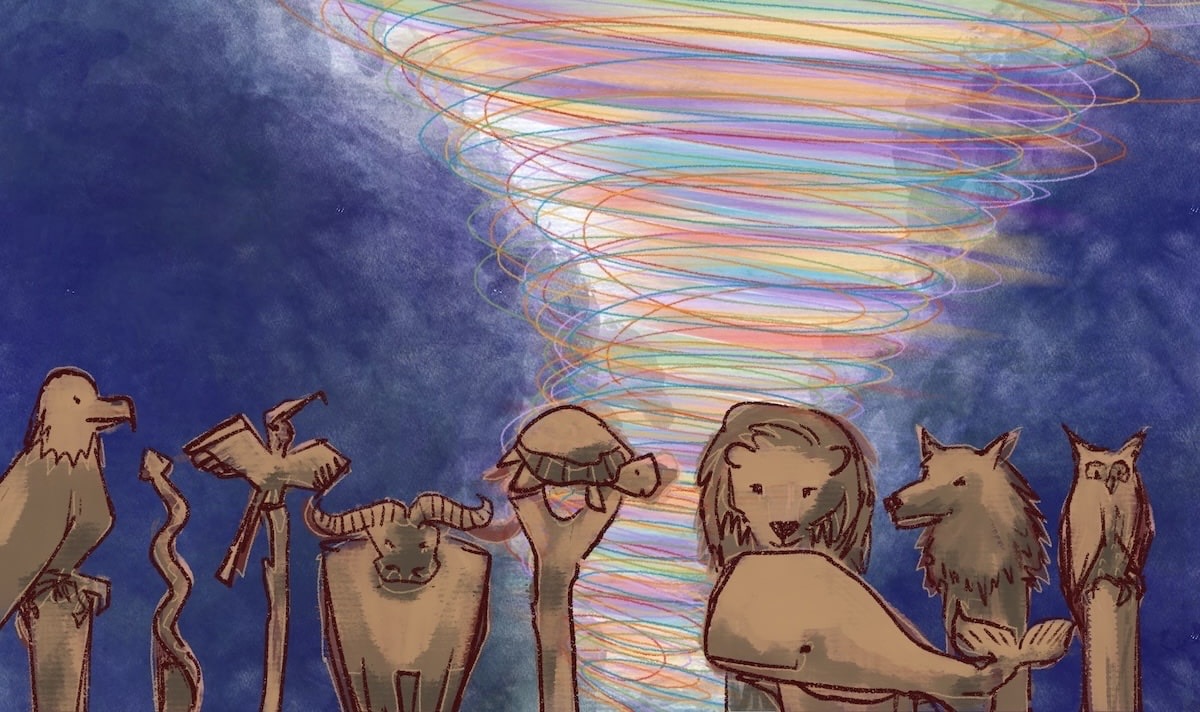
No animal is the one right answer. The mind has endless imagination, and we let it express itself any way it likes, without judgment. If a turtle comes to you, don't try to turn it into a dolphin. Understand what it can do, what gifts it brings you and where it isn't flexible. And it won't be like this forever, only for now.
You can go floor by floor, the same way as in the exercise above, and let each one show you its animal. Whatever comes, write it down and give it a few days. Things aren't always what they seem at first glance, and their deeper layers reveal themselves gradually.
My medicine is acceptance and kindness. For me, that's exactly what self-love is: accepting who I am right now.
Tereza

 I Am a Woman Surfing on a Masculine Wave
I lifted weights, wore pantsuits and performed. Then I found out my…

 Three Acts of a Tangled Relationship with My Dad
Two years of silence with my dad, one simple NLP technique, and…


