
A lotus birth with a newborn on a string | Tereza Kramer
 "Well, now that's a fine bit of extremist nonsense,"
I thought to myself when I first heard that someone doesn't cut a newborn baby away from the placenta.
And as life tends to do, a few years went by, I moved off beyond seven rivers and seven valleys, and in more than a few ways I grew up. Or grew wiser? Well, only time will tell. Either way, my personal fairy tale about the placenta took an unexpected turn.
The very first placenta that kept me company in the womb, I barely remember anymore. I only know from hearsay that I left it grown fast to my mom's belly and it had to be removed by force. I guess I didn't quite manage that one…
And because history repeats itself until those involved consciously turn what they didn't manage into mastery, I went into my first birth with my daughter full of naivety
I thought I'd be singing, smiling, and then suddenly a baby would slip right out of me. It almost happened that way, only the amount of energy it took for our little Sára to slip out far exceeded anything I had been able to imagine until then.
Only that placenta…I, an inexperienced first-time mother, didn't include it in my visualizations, I didn't connect with it, didn't reckon with its existence. I had a vague awareness that it was there, but I paid it no more attention. I didn't imbue it with my consciousness. And so it stayed in my belly, grown fast, perhaps sulking, perhaps grieving, perhaps just because.
The umbilical cord had long since stopped pulsing, the baby had been cut free by her daddy, and I lived through, in the flesh, what "tearing out your insides" means. Thanks to the experienced hand of my midwife, thanks to the whole, intact, heart-shaped placenta that was drawn out of my womb after minutes of suffering and nearly fainting. I guess I didn't quite manage that one…
For my son's birth I prepared already knowing that this time I'd come to an understanding with the placenta and we wouldn't repeat the previous fiasco
And so it happened. The cord stopped pulsing, the baby was cut free, and the beautifully round placenta slipped into the prepared basin the moment I rose from the bed and let gravity draw it out into the light. Hooray! I had learned my lesson, I had managed it!
Each time, my midwife asked whether we wanted to keep it. We had no plot of land where we could plant trees over our children's placentas, so I calmly handed them over for her to do with as she saw fit. Both of those life-giving, living mediators of existence probably ended up somewhere in black bags in the waste bins.
And yet today I see that I still had a lot to learn
During my third pregnancy, the theme of lotus birth began to circle around me. That is, the kind where the baby is born, then the placenta, and you wait until the baby lets go of its own placenta and the cord falls off by itself. From the book Lotus Birth by Shivam Rachana, I learned that six days after the egg and sperm fuse, this organism divides into two halves: one becomes the child, the other the placenta.
"The most important and glaringly obvious aspect of placental psychology is the intimacy and uniqueness of the relationship between the fetus and the placenta. They share the spatially confined environment of the womb, they are always together, very closely bound to the mother's inner feelings and sounds. Their relationship is entirely symbiotic. They cannot exist without each other, and moreover they share completely identical genetic material. They come from the same egg and sperm, which means their cellular structure is identical. They have the same DNA. They resonate together perfectly." (Rachana, p. 75)
I realized that if I hadn't let the cord be cut with my first two children, I would have seen that the placenta is part of the child , part of its body, and I might even have asked myself whether by separating it we cause the newborn some trauma or pain.
I was also moved by a passage describing the placenta from a subtle-energy perspective. I quote from page 34: "The placenta has a very strong aura. Part of the complete placental transfusion is also the transfer of auric energy. The whole process can take two to eight days and is considered complete once the baby's auric field closes. Outwardly, this shows itself in the cord falling off at the navel."
It goes on to speak of the healing of the auric field and the good immunity that follows, of newborns not losing weight, of the deep calm and peace of lotus babies, of the placental trauma of being cut, and also of regressive memories full of pain and confusion after separation from the placenta, and so on.
What can I say, the possibility of a lotus birth spoke to me, enchanted me, caught me
First I attuned myself to my own personal placenta, and for a few days I cherished it in my awareness. I'd fall asleep imagining myself nestling up to it, and it was a very powerful, soothing experience. When I let myself admit that I may have subconsciously missed my placenta my whole life, and that its absence in the first minutes or hours after birth may be part of why I feel incomplete and not enough, I felt the center of my body growing stronger and denser.
That settled it. I spoke to our baby in my belly and explained that, if it wanted and if everything went as it should, we'd give it the chance to keep its placenta for as long as it needed. The little one heard and agreed, and I made the same arrangement with the placenta as well. I paid it due respect and thanks for how perfectly it was caring for the baby.
And so it happened. When our third-born, Marion, floated into our life, the placenta didn't keep us waiting long. It actually came out within ten minutes of the moment my sweet-smelling baby landed on my chest. I only had to whisper to Marion to invite it out, if she wanted to stay connected with it.
It came out whole and we gently placed it in the prepared "Placolander." What had been an ordinary kitchen colander became a ritual object after a friend used it for the same purpose and then lent it to us. Since then it has hosted another placenta, and in the manner of sports trophies the Placolander collects the names of the chosen ones, the ones born on a string who had the honor of using it. And it will keep traveling and gathering signatures.
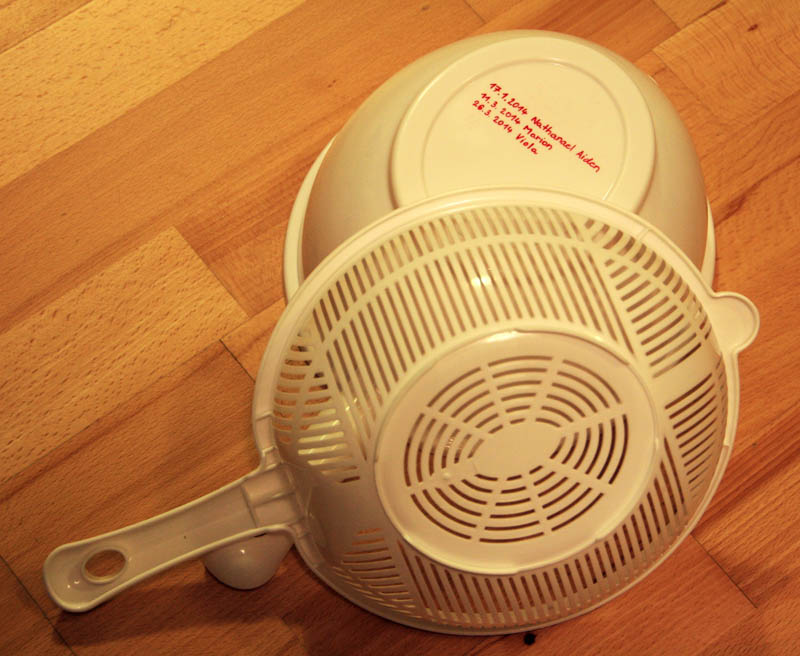
But let's get back to our story. The colander with the placenta rested at my side, and Marion was very calm the whole time, at ease, and showed not the slightest sign of stress. Whether it was because of her uninterrupted connection to her prenatal confidante, or simply because that's how she is, is hard to say.
Even before the birth I had agreed with my husband that I wouldn't be fanatical about the lotus birth, that I'd go by feeling and we'd handle the placenta accordingly
Toward the end of Marion's first day I already felt that handling a baby tethered by a fairly short umbilical cord to a little colander didn't quite suit us. I told myself that if this was how Marion wanted it, we'd carry on until… it fell off.
In the evening, Marion and I talked it over. I told her that in the morning I'd ask her whether she still needed to have the placenta on the string, and that I'd go by her opinion.
At four in the morning, my body sent me to the toilet. It was exactly 24 hours after the birth had begun, and it didn't even surprise me that the womb remembered the hour too, and with one big plop into the bowl finished tidying itself out.
Marion was awake too, my husband was awake too, and so together we simply were, right through two whole hours, until the hands of the alarm clock reached the time of yesterday's birth. Shortly before that, Marion signaled that she wanted to be held over the little potty and rounded off her first day in the world by pooping into it. No meconium, but real, proper baby poo already.
I took it as a sign. She's in our world now, with us. What she had carried from the belly she had now let go of, and so perhaps it was time to cut the placenta as well
My husband felt it the same way. I looked into the deep, wise eyes of our newborn daughter and asked whether we could cut the cord. She gazed calmly, eyes wide open, her look steady, her whole body relaxed.
"If you don't want to, just whimper, or cry. Or wave your little arms." But none of that happened. Our baby rested in complete peace and acceptance of life. My husband and I glanced at each other and each of us spoke to the placenta, thanked it, and assured it that we would take proper care of our little girl.
The umbilical cord was already dried up, like a little twig, and my husband cut it. I watched Marion's face and her expression stayed calm and relaxed as before. I assured her that we'd keep the placenta in the Placolander near us for one more day. The following morning, I moved the placenta into a round little box, labeled it in decorative script, and placed it in the freezer.
"When we're on our own land, we'll plant a sakura over it for you, would you like that?"… and Marion again gazed with that look of hers that sees all the way to the end of the universe, and I took it to mean that she agreed without objection.
And so our lotus birth came to an end…24 hours with the baby on a string and another day close to the placenta
We all felt that this was okay and right.
The older children were very interested in the placenta. They looked at it, touched the umbilical cord, and when my husband rummaged in the wardrobe and, to each of them, handed a velvet placental pillow together with the cord, which I had secretly sewn for them before the birth, they were all abuzz.
"Mine is shaped like a heart," little Sára rejoiced. "Yes, that's exactly how yours really was."
"And mine is like the ring of Saturn," mused four-year-old Theo. It would never have occurred to me how much more nobly you could describe an ordinary circle!
And then they ran off into the living room, where they started playing with their red pillows, wrestling, tickling and teasing each other…. because when you catch the umbilical cord at its end and start spinning fast, your placenta turns in an instant into a lovely plush flail.
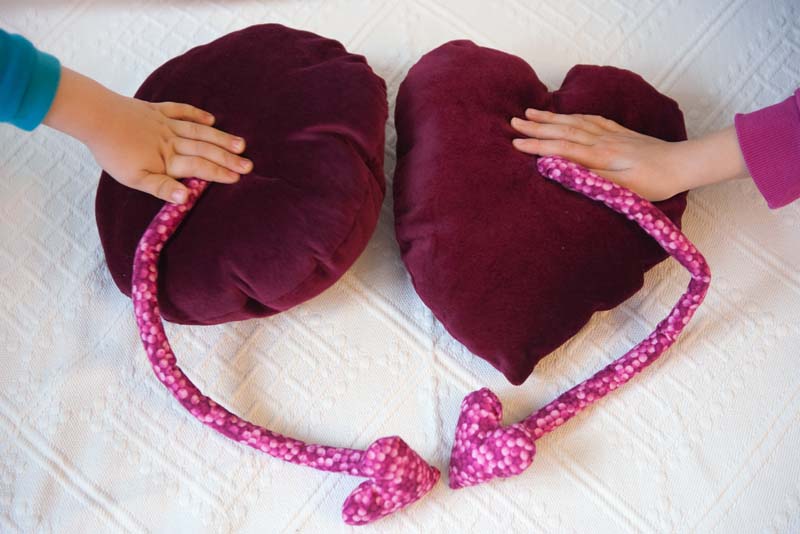
The pillows found their place in the cribs and became a symbolic stand-in for the children. Theo reassured Grandma that he wouldn't be sleeping in her bed tonight: "you can take my placenta there instead."
Now all that's left is to sew an oval-shaped pillow for Marion. The beautiful decorated pouch I sewed for her drying placenta, in case we had left it attached all the way to the end, I tucked away in her dresser. For when she needs a hiding place for her wooden animals, or has nowhere to put her hair ties and clips, that's when we'll come across it.
"Beautiful, life-giving Tree of life, placenta, we thank you for what you have done for us and for our children. You are a part of us, and were it not for you, we would not be here either. We hold you in reverence and will stay mindful of what you have taught us. The sense of peace, calm and rightness from meeting you is written indelibly into our family."
P.S. If lotus birth has caught your interest, go and study it. It's a fascinating subject, and it opens up connections between our relationship to life, to food, to partnership, to violence…to knowing ourselves and trusting life. Once you get past the ingrained ideas about how the umbilical cord "should" be handled right after birth, a whole new view of life opens up.
Bibliography:
Lotus Birth, Rachana Shivam. Tvořivá škola, 2013.
www.lotosovyporod.cz

 Birth by cesarean section in a spiritual context
In this talk I'll tell you the story of Karla, who had a birth trauma…


